


 Home

 News

 Blogs

 Podcast

 Photos

 Videos

 Publications
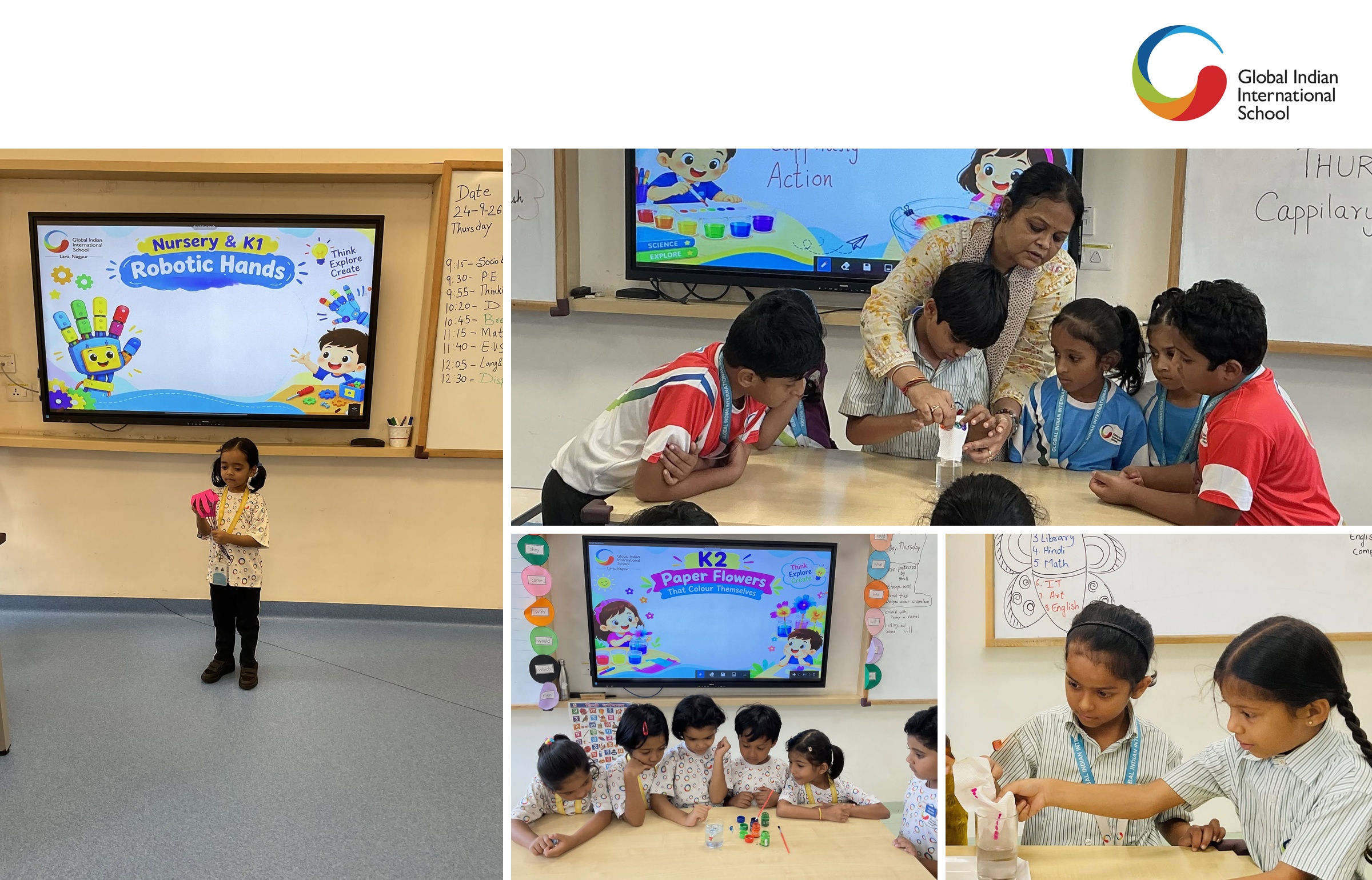


Students at Global Indian International School (GIIS), Lava, Nagpur spent Thursday 24 September 2026 learning science by doing it. The school's Thinking Thursday activity gave children from Nursery to Grade 2 experiments to try, watch and talk about.
Each group worked on an activity suited to its age and learning level. Nursery and K1 students took on the Robotic Hands Science Project, which introduced them to movement and how things function. A human hand bends its fingers when muscles pull on tendons, and robotic hand models are built to copy that kind of movement.
K2 students made Paper Flowers That Colour Themselves. When the paper came into contact with water, students watched the colours travel through it. The activity gave them a visible way to see that water can move colour from one part of the paper to another. It follows the same idea as the experiment done by Grade 1 and Grade 2.
Students in Grade 1 and Grade 2 took part in the Rainbow Colour Experiment. They made small dots on paper using different rainbow colours and carefully placed the paper in water. As the paper absorbed the water, the colours spread out and formed patterns. The experiment helped students understand how water moves through paper and how colours can travel along with it. Paper is made of fibres with small gaps between them, and water moves through those gaps, taking the colour with it. Students could follow the colour to see how far the water had reached.
Across all three activities, students were asked to observe, predict, explore and discover. Predicting meant deciding what they expected to happen. Observing meant checking that expectation against what they saw.
The session had several learning outcomes. Students developed curiosity and interest in scientific exploration, and they built up their observation and prediction skills. They also came to understand simple scientific concepts through hands-on experience, such as how movement works and how water travels through paper.
The activities also encouraged creativity and experimentation. As students shared their observations, their communication and confidence grew, and participation was active across the groups.
Parents who want to continue the conversation at home can ask their child what happened to the colours and what they thought would happen first.
- 0
- 0
Comments ({{totalComments}})
Login to post a comment...
{{comments.CommentText}}