


 Home

 News

 Blogs

 Podcast

 Photos

 Videos

 Publications
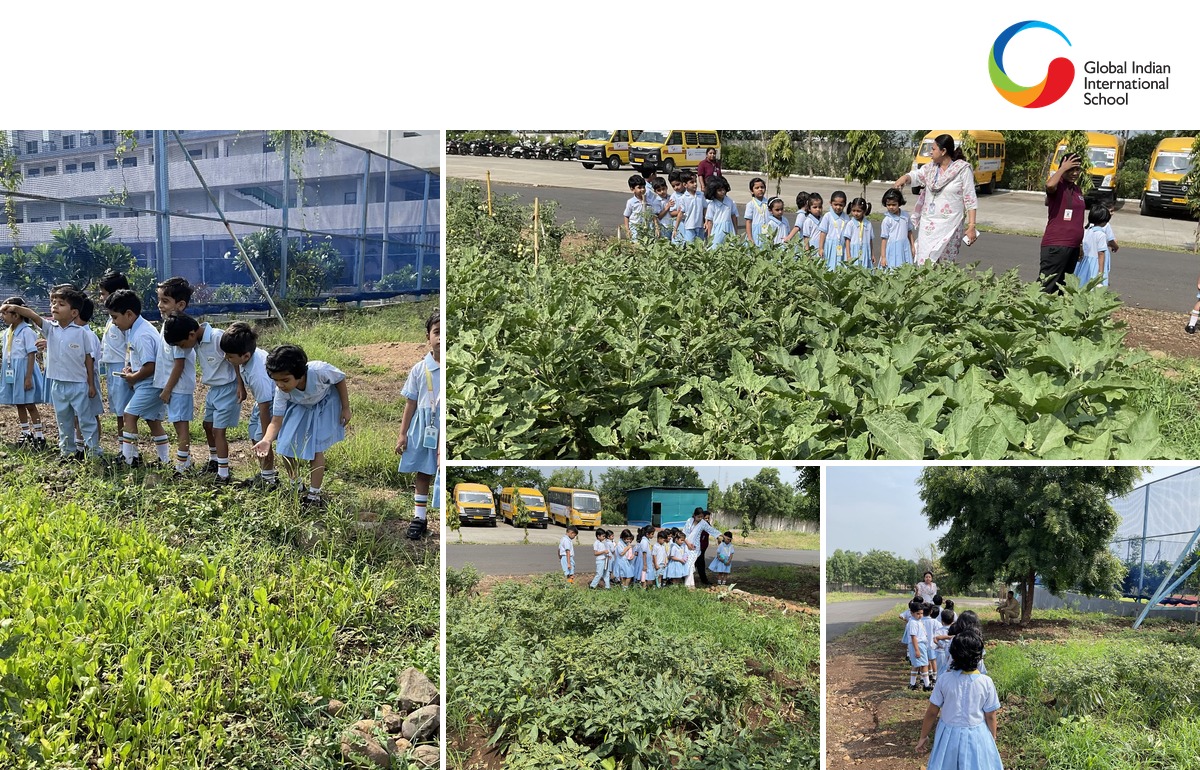


The K2 students of GIIS Nagpur, from sections A and B, visited the school kitchen garden as part of their experiential learning. The visit gave the children a first-hand look at how vegetables are grown.
Experiential learning at this level means children learn by taking part. They observe, ask questions and handle real materials, so the garden works as an extra classroom for the day. A kitchen garden is a useful setting for young children because it grows vegetables and herbs that are used in cooking. The plants are familiar from home, and the link between a plant and a meal is easy to see.
In the garden, the students explored the different vegetables growing there and observed how each one is grown. They learned that plants grow in different ways and were introduced to four types: creepers, climbers, herbs and shrubs.
Creepers spread along the ground, and gourds are a common example. Climbers grow upward and hold on to a support such as a stick or a net, as beans and peas do. Herbs are small, soft-stemmed plants, and many of them, such as mint and coriander, are used in cooking. Shrubs are woody plants with several stems that stay lower than trees.
The students also observed the leaves, stems, flowers and vegetables of the various plants. Looking at these parts on a real plant lets children compare shape, size and colour for themselves, which is harder to do from a picture in a book. A thin leaf next to a thick stem, or a small flower next to a full-grown vegetable, shows differences that are easy to see and easy to talk about. Vegetables are the part children already know best, so they are a natural place to start before looking at the rest of the plant.
Each part of a plant has a job. Leaves make food for the plant using sunlight. Stems carry water up from the roots and hold the plant up. Flowers are where many vegetables begin, since the flower on a plant such as a gourd or a tomato turns into the vegetable itself. Seeing this on a living plant gives young children a first picture of how a vegetable gets from the soil to the kitchen.
The field visit helped the students develop an interest in gardening and increased their awareness about plants, vegetables and the importance of nature.
- 0
- 0
Comments ({{totalComments}})
Login to post a comment...
{{comments.CommentText}}