


 Home
Home

 News
News

 Blogs
Blogs

 Podcast

 Photos

 Videos

 Publications
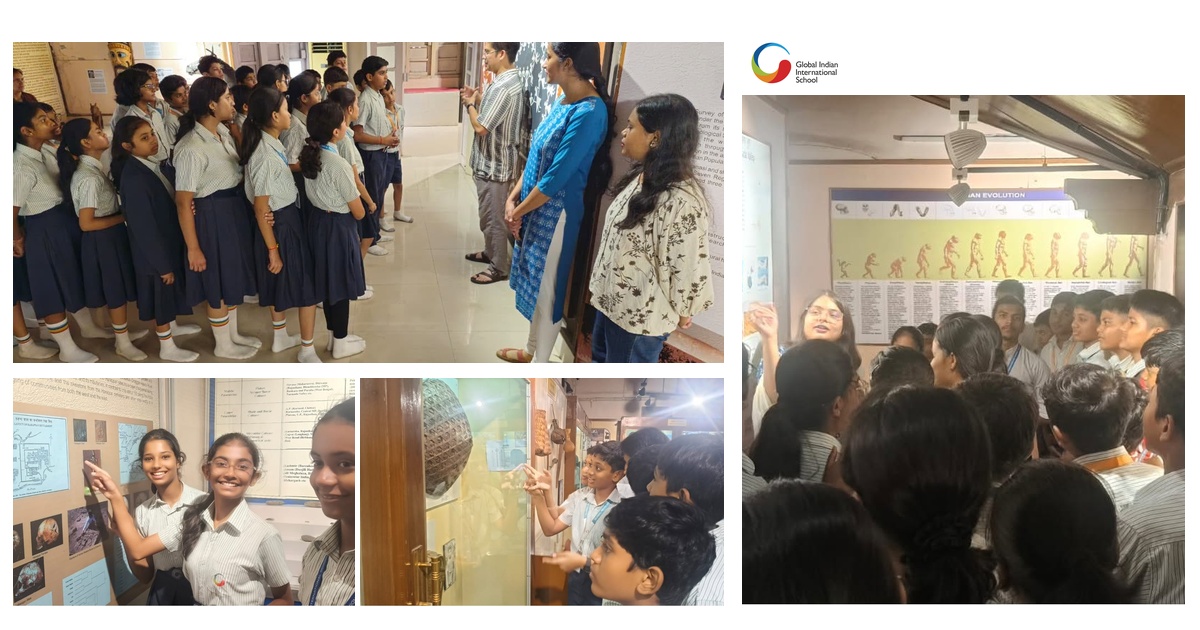


Students of Grades 6 to 8 at Global Indian International School, Nagpur recently stepped outside the classroom for a field visit to the Zonal Anthropological Museum, turning textbook chapters on human history into a real, hands-on experience. The visit was organised to help students connect what they learn in class with actual artefacts and exhibits, making subjects like history and anthropology feel far more real and relatable.
The museum trip covered a wide range of topics. Students began by learning about the origin of the universe and how life evolved over millions of years. From there, they moved on to primates, understanding the traits that link them to early humans, before exploring detailed exhibits on human evolution itself, tracing how humans changed physically, socially and culturally over time.
A major highlight of the visit was the Stone Age section, where students examined actual tools used by early humans for hunting, cutting and scraping. This was followed by exhibits on the Harappan Civilization, one of the earliest urban civilizations in the Indian subcontinent, giving students insight into how organised and advanced early Indian society already was.
The visit also introduced students to India's diverse traditional communities. They saw fishing and agricultural tools, everyday household items, traditional clothing and jewellery, and pottery and terracotta work, each offering a window into how different communities lived, worked and expressed their identity. The trip concluded with a look at folk paintings and tribal art, showing students how art has long been used to reflect beliefs, traditions and community life.
For parents, this visit reflects the school's continued effort to make learning experiential rather than purely textbook-based. Seeing real artefacts and exhibits helps students retain concepts far better than reading about them alone, while also building curiosity, observation skills and a genuine appreciation for India's cultural diversity.
By the end of the day, students had gained a clearer, more grounded understanding of human evolution, ancient civilizations and traditional Indian culture, exactly the kind of learning that stays with children well beyond the classroom.
- 0
- 0
Comments ({{totalComments}})
Login to post a comment...
{{comments.CommentText}}