


 Home
Home

 News
News

 Blogs
Blogs

 Podcast

 Photos

 Videos

 Publications
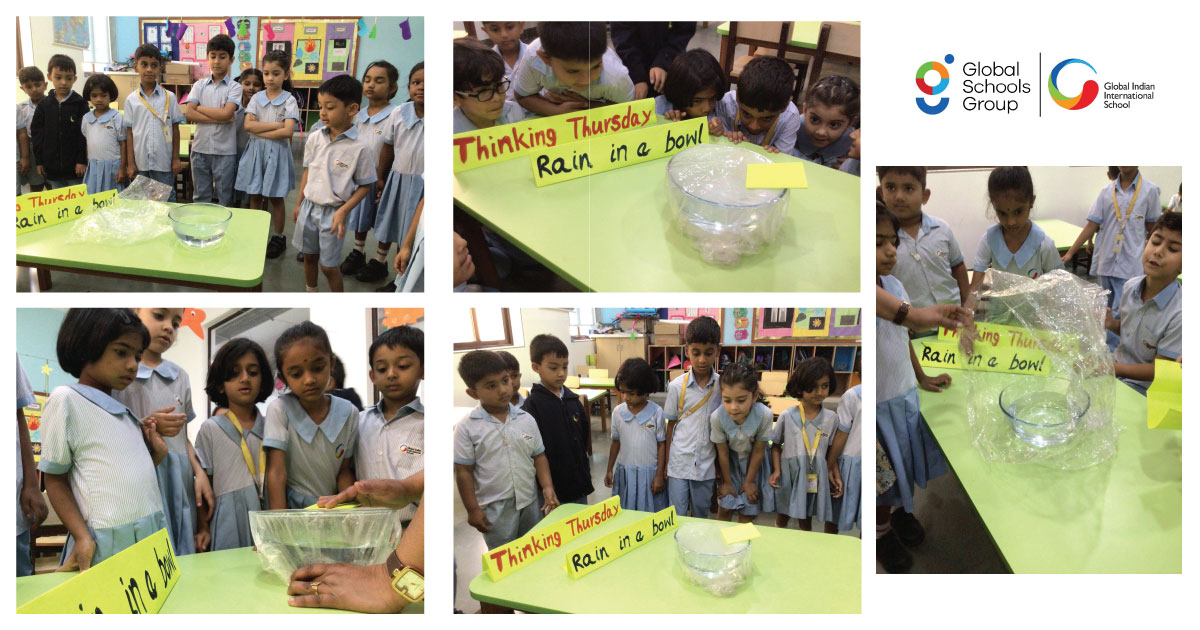


For children to truly understand science, they must be given the opportunity to explore, observe, and experiment. When learning becomes hands-on and connected to everyday life, curiosity naturally grows. Keeping this in mind, we introduced our students to a simple yet fascinating activity called “Rain in a Bowl” to help them understand the water cycle.
The teacher began by filling a coloured bowl with water and covering it tightly with plastic wrap. The children watched with excitement and curiosity, eagerly waiting to see what would happen next.
As time passed, the teacher explained how the water in the bowl slowly warmed and began to turn into vapour. This process, known as evaporation, is when water changes from a liquid into a gas and rises into the air. The students observed carefully, realising how something so common in nature could be recreated right in their classroom.
After some time, tiny droplets started forming on the inside of the plastic wrap. The teacher explained that this was condensation, the stage where water vapour cools down and changes back into tiny drops of liquid. The children were fascinated to see these droplets appearing before their eyes.
Soon, the droplets grew larger and heavier. One by one, they began to fall back into the bowl like tiny raindrops. This stage represented precipitation, completing the cycle as the “rain” returned to the water below.
Through this simple activity, students were able to clearly visualise how water travels from the earth to the sky and back again in a continuous natural process. More importantly, they experienced science not as a theory from a textbook, but as something they could observe, question, and understand through experience.
Activities like these help children realise that science is a way of understanding the world around them.
- 0
- 0
Comments ({{totalComments}})
Login to post a comment...
{{comments.CommentText}}