


 Home

 News

 Blogs

 Podcast

 Photos

 Videos

 Publications
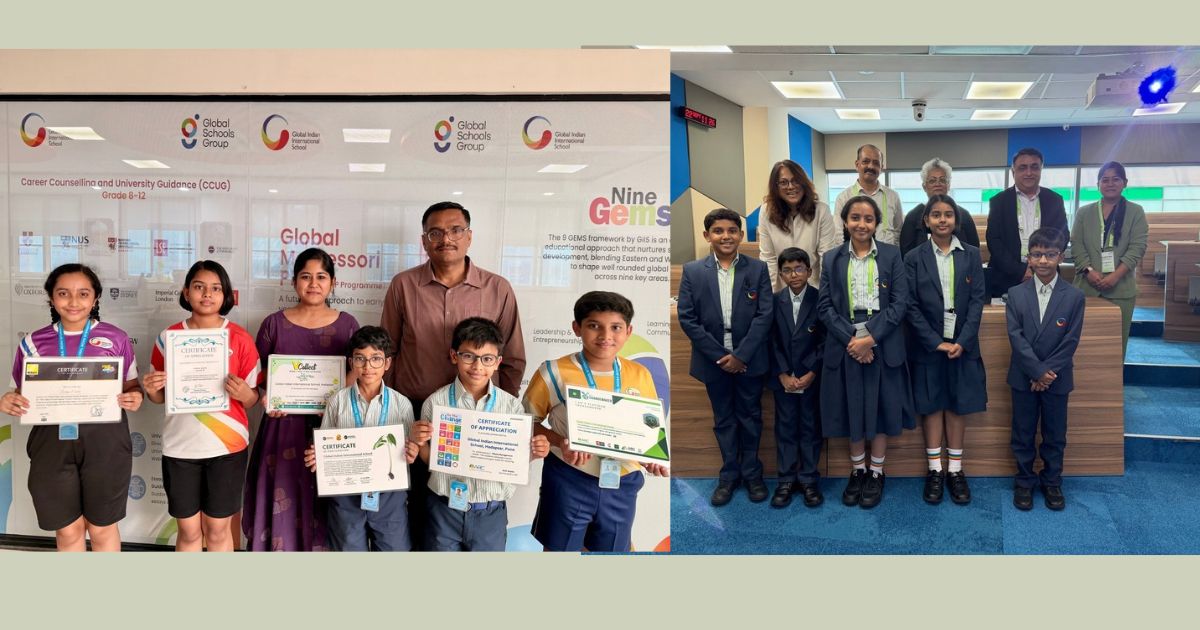


Five students from Grades 4 and 5 showcase their sustainability initiative, E.C.H.O. 360°, at GED–MCOP 2026 in Singapore, demonstrating how small actions can create meaningful environmental change.
What happens when young learners turn their concern for the environment into purposeful action? At GIIS Hadapsar, five students found their answer through E.C.H.O. 360° – Empowering Communities through Healthy Habits and Opportunities, a student-led sustainability initiative focused on climate action and responsible living.
Lokya, Anay, Avyaan, Vaidik and Riddhi, representing Team Climate Guardians, showcased their work at GED–MCOP 2026 in Singapore. With the encouragement of Principal Dr. Vijay Singh Parihar and under the mentorship of Ms. Swati Somani, the students developed five initiatives that brought together environmental awareness, community participation and measurable outcomes.
Five Initiatives, One Shared Purpose
The team's work focused on five areas of environmental responsibility:
1. Growing Green – Plantation and Tree Monitoring
The students planted and monitored 126 saplings, introducing unique Tree IDs and regular observations to track their growth and health. The initiative recorded an estimated carbon-related impact of 932.8 kg CO2e, highlighting the importance of nurturing trees beyond the day of plantation.
2. Mission Green – Recycling Drive
Through a school-wide collection drive, the team collected 164 kg of recyclable waste, including plastic, metal and electronic waste. The activity helped students understand waste segregation, responsible disposal and the importance of reducing everyday consumption.
3. Nikon Green – Stories of Change
Using photography and visual storytelling, the students explored creative ways to communicate environmental messages. The initiative encouraged them to use images to raise awareness about nature conservation and inspire responsible choices.
4. 20 Healthy Habits – Everyday Sustainability
The campaign reached 400 students, encouraging healthier and more sustainable daily practices. It also documented 60 kWh of electricity saved, equivalent to an estimated reduction of 42 kg CO2e.
5. Green Commute Challenge – Greener Journeys
Encouraging students to walk or cycle to school, the initiative recorded an increase in participation from 273 students on a usual day to 462 on Green Commute Day, representing an approximately 70% increase. The estimated carbon-related impact was 136.1 kg CO2e.
Measuring the Impact of Collective Action
Across their initiatives, the students recorded 126 saplings planted and monitored, 164 kg of waste collected, 400 students reached, 60 kWh of electricity saved and a 70% increase in walking and cycling participation.
Based on the project's calculations, the four quantified carbon-related impacts together amounted to approximately 1.33 tonnes of CO2e. The team also explored a potential future impact of approximately 44 tonnes of CO2e if the initiatives are sustained and scaled over time.
- 0
- 0
Comments ({{totalComments}})
Login to post a comment...
{{comments.CommentText}}