|
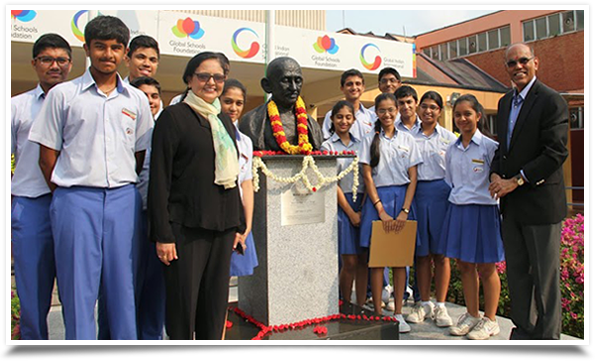
 Shubham Saraf, GIIS Queenstown Campus: Sir, can you provide us insights behind your professional transition from the field of physics to that of economics? Does economics interest you more than physics? Shubham Saraf, GIIS Queenstown Campus: Sir, can you provide us insights behind your professional transition from the field of physics to that of economics? Does economics interest you more than physics?
Dr Subbarao: I believe that education is an unending process. No matter how much you study in school or college you are never prepared for the real world. No career options for Physics led to Civil service and Economics seemed most interesting and after that it was difficult to go back to Physics.
Rithvik Alluri , GIIS Tokyo Campus: India is at a very critical juncture, with a new Government with a strong mandate and lots of promises. What according to you are the key initiatives that the Government should take to push the economy up to the next level? And what are the risks we have?
Dr Subbarao: Structured reforms increase productivity and investment. If structural reforms are not implemented with credibility, it will create inefficiency and recession. Strong reforms are conducive to market liberalization. Investors look for better labour laws, economic returns. The potential effects of the reforms on output, employment, productivity and competitiveness are sizable. The benefits of economic growth must reach all parts of the society. The risk is it might go into a vicious cycle if investors pull out from the market.
Devanshi Patnaik, GIIS East Coast Campus: Can you please explain the concept that economists must treat economics as a people’s matter?
Dr Subbarao: It is a stereotype that economists forget it is a people’s matter. They must concern themselves with the concerns of the people (mainly poor people). (An) economist uses the techniques of microeconomics to gauge the happiness economics in a country. What policies they pursue does make a difference in the lives of the people.
Shreya Tripathi, GIIS Queenstown Campus: The stereotypical response from economists is that they didn’t perceive the crisis coming because the world has changed. What is your opinion on this matter?
Dr Subbarao: This is not entirely true some economists predicted it but they could not tell what exactly will happen. Economics is not just about risk management, it is also about people’s behaviour. Monetary policies, market prices, allocation of resources are determined the way people behave in a particular country. People buy things more on intuitive decision rather than making an informed judgment based on scientific decision making process.
Bhawani Ponnurangan, GIIS Kuala Lumpur Campus: The Indian economy is growing and customer behaviour is changing. People are taking more credit (loans/ credit cards are more common now than before. We know that the last global financial crisis was a credit crisis. How is the RBI going to enhance credit growth, which is good for the economy and maintain control so that it doesn@aps@t get overdone?
Dr Subbarao: Another challenge for RBI is that they want to make the credit to be used for productive purposes. They do not want another bubble to come up. RBI monitor credit dynamics to try prevent a bubble. Bubble is created when the prosperity is created with the expansion of unlimited credit provide by banks or financial institutions. The prices of asset rise above their true value until there is a freefall of the price and the bubble bursts which is not good for the market.
Tanisha Mishra, GIIS Queenstown Campus: Can you analyse the reasons for the fall of the value of the Indian rupee over the last few years?
Dr Subbarao: From INR 50 to INR 61 in a few months it makes it for around20%depreciation. This hurts the economy. The exchange rate is controlled by restricting the amount of foreign currency or local currency that is allowed to be traded or purchased in a particular country. Every government tries to achieve relative exchange rate in order to improve business confidence. Indian rupee depreciated because spending on imported goods and service is greater than revenue received from exported goods and services. There was more demand for foreign currency increased vis-a-vis Indian currency and the currency took a hit.
Ramya Srikanth, GIIS Queenstown Campus: How far do you agree with the ideas of globalisation and liberalisation in India? Has it brought any change to the Indian economy since the year 1991?
Dr Subbarao: India has globalized. It is both good and bad - good because we have become a part of the global economy and which have made us more competitive. It is bad also because a global financial crisis has its effect on us too. The challenge is to reduce the cost and maximize the benefits of globalization to our people.
Varsha Menghani, GIIS East Coast Campus: Many countries have started printing plastic notes instead of paper currency. Why are we not introducing plastic currency notes in India?
Dr Subbarao: The central bank will soon introduce on a pilot basis plastic currency notes as they have less carbon foot print than paper notes. The RBI is trying to introduce plastic currency and will introduce it on trial basis and if that succeeds it will be replicated in the entire country. India being a large country unlike Singapore, and to make such change acceptable has both social and economic challenge. However, plastic note is environment friendly and it has longer shelf-life than the paper notes.
Sriniketh Sukumar, GIIS Queenstown Campus: Can you please explain the paradox that while money is printed by governments they cannot print all they need? Why is this so?
Dr Subbarao: Such money will have no value. We must make our country richer by making more products and providing good services. The reason is that printing more money doesn’t increase economic output in any way it merely causes inflation. Suppose a person gets $5000 and with that money he buys the things he needs or wants, if the government doubled the money supply, we would get $1000, if there is no increase in the supply of goods and services in the market the demand would rise and firms would push up prices.
|


 Home
Home

 News
News

 Blogs
Blogs

 Podcast

 Photos

 Videos

 Publications




Comments ({{totalComments}})
Login to post a comment...
{{comments.CommentText}}