


 Home
Home

 News
News

 Blogs
Blogs

 Podcast

 Photos

 Videos

 Publications
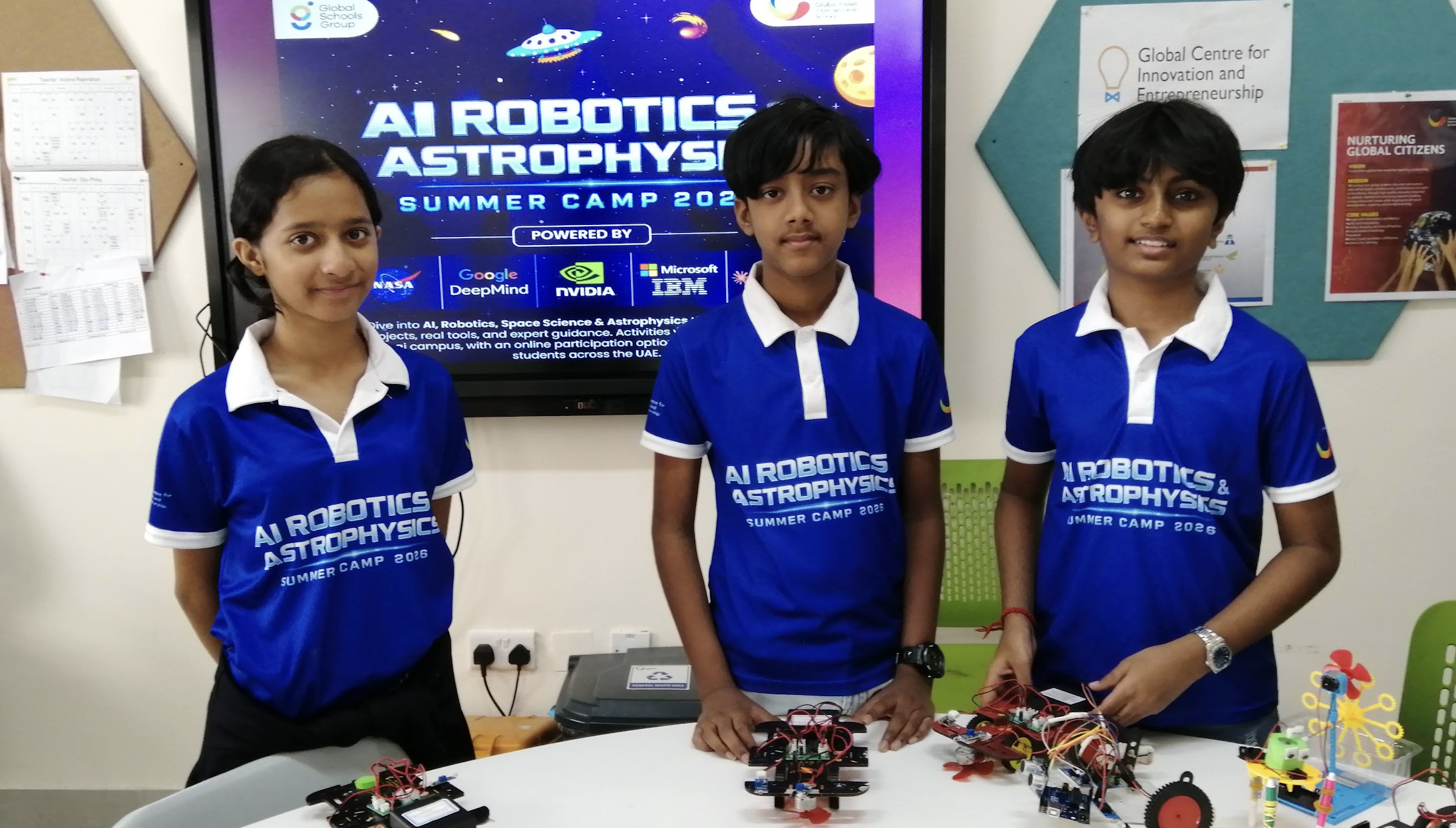


What if a summer holiday could become a launchpad for the next generation of scientists, Space engineers and innovators?
That question came alive at Global Indian International School (GIIS) Dubai, where students embarked on an exciting three-week journey through Artificial Intelligence, Robotics, Astrophysics and Space Science during the AI Robotics and Astrophysics Summer Camp 2026, held from 7 to 23 July 2026.Instead of simply reading about, artificial intelligence or space, students designed, built, experimented and tested their ideas.
Organised under the guidance of the Global Centre for Innovation and Entrepreneurship (GCIE), GIIS Dubai, the camp brought together technology, science and creativity in an engaging learning experience for students across age groups.From programming AI-powered robots to exploring galaxies, designing Moon habitats and developing space exploration systems, the three-week programme encouraged students to question, design, build, test and innovate.
Week 1: Entering the World of AI, Robotics and Space
The first week introduced students to the foundations of Artificial Intelligence and Robotics.Students learned how intelligent machines work, programmed and tested robots, and took part in challenges that developed logical reasoning, computational thinking and engineering skills.The journey then moved beyond Earth.
Students explored the Solar System, stars, galaxies, black holes and exoplanets and experienced space exploration through immersive Virtual Reality. They also learned how satellites are used for Earth observation and deep-space missions and explored how AI and robotics could support future space exploration.Engineering became the focus as students moved from ideas to physical creations. They designed digital models using Computer-Aided Design (CAD), created 3D models and experienced the process of turning digital designs into physical objects through 3D printing.
The week demonstrated how science, technology, engineering and creativity can come together to transform an idea into something tangible.
Week 2: Building for the Future of Space Exploration
Week 2 took the students deeper into Astrobotics, engineering and space exploration.One of the key challenges was designing space exploration robots capable of investigating rocks, minerals and challenging extraterrestrial environments.
Students explored how robots could be used in places where humans may find it difficult or dangerous to operate.They also designed sustainable Moon habitats, combining space science with engineering, architecture and 3D design. While working on their habitats, students had to think about the needs of future astronauts and the challenges of living beyond Earth.The students also explored concepts such as telepresence in space, autonomous systems and human-robot collaboration.
Engineering challenges extended beyond space. Students explored the principles behind weaving machines, helicopter flight and navigation, vacuum pumps and mechanical systems, helping them understand how scientific principles are applied in everyday technologies.The focus throughout the week was on moving from an idea to a prototype — encouraging students to think, build, test and improve.
Week 3: AI and Engineering for Space Missions
The final week brought together the learning from the previous two weeks.Students began by designing satellites and exploring their role in communication, navigation, Earth observation and deep-space missions.They conducted experiments related to gravity, comparing gravitational forces on different planets and considering what these differences could mean for future space exploration.They also conducted chemical analysis experiments to understand material reactivity and explored how chemistry can contribute to the development of technologies capable of operating in the challenging conditions of space.One of the major collaborative projects was the creation of a futuristic Space Arena.Students designed and developed models incorporating elements such as launch pads, astronaut habitats, communication towers, research facilities and robotic exploration zones.They also explored the role of Artificial Intelligence in autonomous satellites, robotic explorers, mission planning and planetary data analysis.
As the week progressed, students developed Astrobotics accessories and robotic components for their Space Arena missions. They also explored AI-powered communication systems and how intelligent technologies could connect robots, smart devices and future space habitats.
AI for Future Space Missions
The final stages of the camp focused strongly on AI for space exploration.
Students explored how Artificial Intelligence can support Autonomous navigation,Object detection ,Mission planning ,Communication ,Decision-making,Robotic exploration,Analysis of planetary data.They followed an engineering design cycle of Imagine, Design, Build, Test, Improve and Innovate, applying what they had learned throughout the camp to refine their projects.By the end of the programme, students were not simply demonstrating individual activities. They were integrating AI, robotics, engineering and space science into complete projects.
Young Innovators Share Their Experiences
For the students, the hands-on nature of the camp was one of its biggest attractions.
Shashank Subhash, Grade 8A, said:
“The camp gave us a chance to actually build and experiment. Learning about AI and robotics became much more interesting when we could see our ideas working.”
Param Shah, Grade 7A, said:
“I enjoyed learning how robotics can be used in space exploration. It made space science feel much more real.”
For younger students, the experience was equally engaging.
Kiaan Mengu, Grade 4A, said:
“I loved designing and making things. The robotics and space activities made learning feel like an adventure.”
Zara, Grade 4B, added:
“I enjoyed learning through activities and working with technology. It was exciting to see our ideas become real.”
From Curiosity to Innovation
According to Siju Philip, Chief Camp Leader and Head of GCIE, GIIS Dubai, the programme was designed to develop much more than technical skills.
“The purpose of the camp was not simply to introduce students to AI, robotics or astrophysics. We wanted them to experience the process of innovation — asking questions, building ideas, testing them and improving them. When curiosity becomes capability, learning becomes much more powerful.”
The camp reflected the wider approach of GCIE, which focuses on giving students opportunities to explore emerging technologies, develop solutions and build confidence through hands-on innovation.
Throughout the three weeks, students were encouraged to work collaboratively, solve problems and learn from their experiments.
The Grand Finale
The final day brought the three-week journey together with a Grand Finale exhibition and prize distribution ceremony.
Students presented their AI-powered robotic models, Astrobotics innovations, engineering prototypes, scientific investigations and space exploration concepts.
Through live demonstrations and presentations, they explained the science and research behind their projects and demonstrated the skills they had developed during the camp.
The prize distribution recognised achievements across areas including innovation, creativity, research, engineering design, teamwork, presentation, perseverance and scientific thinking.
Every participant also received a certificate recognising their participation and learning journey.
For many students, the Grand Finale was more than a celebration. It was an opportunity to confidently present something they had imagined, designed, built and improved themselves.
Preparing Students for Tomorrow
Ms. Anita Singh, Principal, GIIS Dubai, said:
“Our students will grow up in a world shaped by AI, robotics and new technologies. Experiences like this camp give them the opportunity to explore these technologies in a practical and meaningful way. More importantly, they develop curiosity, creativity, collaboration and confidence — skills that will help them shape the future.”
The camp demonstrated the importance of giving students opportunities to experience emerging technologies at an early age.
Instead of simply learning about innovation, students experienced the innovation process themselves.
They learned that an idea can become a design, a design can become a prototype, and a prototype can be tested and improved.
A Journey Beyond the Classroom
Over three weeks, the students travelled from the fundamentals of AI and robotics to the challenges of future space exploration.
They programmed robots.They explored the universe through VR.They designed 3D models.
They studied satellites and gravity.They designed Moon habitats.They built space exploration robots.They experimented with engineering systems.They created Space Arenas.And they explored how AI could help future missions to the Moon and Mars.But perhaps the most important outcome was not any individual project.
It was the confidence to ask questions and the courage to try new ideas.
The AI, Robotics and Astrophysics Summer Camp 2026 showed that when young learners are given the right tools, guidance and freedom to explore, a classroom can become a laboratory, a robot can become an explorer and a simple question can become the beginning of an innovation.
The camp may have concluded on 23 July, but the curiosity it created will continue.
From AI robots to the cosmos, GIIS Dubai’s young innovators have taken another step towards understanding and shaping the future.
- 0
- 0
Comments ({{totalComments}})
Login to post a comment...
{{comments.CommentText}}