


 Home
Home

 News
News

 Blogs
Blogs

 Podcast

 Photos

 Videos

 Publications
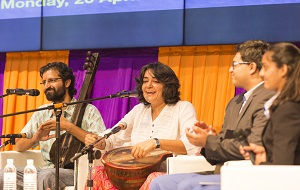


GIIS students were inspired by the wisdom from verses of the 15th century mystic poet Kabir by filmmaker and writer Ms Shabnam Virmani and poet Mr Vipul Rikhi from the Kabir Project under the GIIS Leadership Lecture series at GIIS Queenstown Campus on 20 April 2015.
Kabir, one of India’s great religious poets, in the fifteenth century and remains extremely popular within and beyond India. Kabir’s oral traditions have gone on continuously since his lifetime, producing a rich array of musical forms, folk and classical. To enlighten students on verses of Kabir, Ms Virmani and Mr Rikhi participated in a panel discussion where more than 200 students watched them perform Kabir’s dohas with rapt attention.
The event was hosted by four students from GIIS Queenstown Campus. Students from Class 11, Vignesh Raman and Aashay Chouhan; Class 10 student Manaswini Talagadadivi; and from IB Year 1, Siddhi Raman—had interaction with Ms Virmani and Mr Rikhi, along with others.
The artists were in Singapore to perform at a series of concerts at the Esplanade from 18 to 19 April 2015. Their visit to GIIS Queenstown Campus rekindled students’ interest in the wisdom of Kabir’s writings through songs accompanied by traditional Indian instruments such as the tanpura and the manjira.
Ms Virmani and Mr Rikhi started the conversation by thanking the student panellists for their thorough research on the Kabir Project. Ms Virmani said, “I must confess, both Vipul and I are both impressed and taken aback with the amount of research that has been done about us. The effort that all of you have put in to make this reception for us here so warm, alive and vibrant. We have had opportunity to take Kabir to schools and interact with children in India, but this is the first time we have had this opportunity in Singapore.”
Mr Rikhi explained, “The reason we chose to sing, rather than recite, Kabir’s poetry is because when we sing, the ideas, feelings and knowledge becomes embodied. It comes into the body—it not only stays in the mind.” He further explained that many of Kabir’s poetry introduce striking images of the body because the body is the site where wisdom begins.
After the short introduction to the Kabir Project, Ms Virmani and Mr Rikhi encouraged all the students gathered at GIIS Queenstown campus hall to sing along to a song from the Malwa Madhya Pradesh, titled “Within this Earthen Vessel,” a popular Kabir poem that likens the earthen pot to the fragility of the body.
Following the lively number, in which GIIS students enthusiastically sang and clapped along to the infectious beats of the manjira, the artists shared a couple of parables.
The first was a modern-day parable about a girl named Attentia who found that in order to find her true match, she had to look within herself. The second parable was a traditional tale about a parrot who saved his beloved sandalwood tree through an act of pure love.
Ms Virmani and Mr Rikhi displayed immense humility and wisdom as they fielded questions from students during the question and answer session. Jaanvi G K of IB Year 1 asked, “What attracted you to the poetry of Kabir?” To that Ms Virmani said, “One answer to that is that Kabir comes without brand identity. Kabir is someone telling you, ‘Watch it! There is a lot of danger (with brand identity).’ If you get your identity all confused with brands you forget who you are. Who you are is beyond brands or labels.”
As passionate musicians and artists, Ms Virmani and Mr Rikhi are keen to share the intentions and meanings behind Kabir’s poetry. Answering the question from Rishabh Anand of IB Year 1 on what would be his suggestion to educators to take Kabir and his teachings to the classroom, Mr Rikhi said, “I would like urge teachers to share the wisdom of Kabir in the multiple dialects in which his voice flows. Kabir didn’t write his poems, he passed down his words through the oral form. Today, Kabir sounds alive through a vibrant oral tradition that inhabits 20 to 25 dialects. Also, thanks to the Internet, a lot of his poetry are available online. I urge classrooms to open their doors to other languages and dialects in which Kabir thrives.”
Ms Virmani observed that many young Indians grow up thinking that Kabir is a moralistic figure telling one how to live his or her life. However, she urged students to think of Kabir as something much more. She said, “He is Rocky. He is a lot of fun. He asks a lot of questions. He challenges you. He challenges the system in which you are being taught in a moralistic way.”
Departing slightly from the discussion about Kabir’s poetry, IB Year 1 student Tanya Ramesh asked Ms Virmani why she had chosen to spread Kabir’s message through documentaries. Ms Virmani replied, “A while ago, I was on a journey myself. I was asking all the questions on these journeys, and I wanted to carry my audience with me on this journey. Over the years, filming documentaries on these journeys became a powerful and spontaneous way to share my learning with audiences.”
Ms Virmani and Mr Rikhi’s visit to GIIS Queenstown proved to be truly inspiring. Student panellist Siddhi Raman of Class IB Year 1 said, “Before this lecture, I thought of Kabir as just another chapter in my textbook. Now, I understand what his poems really mean. In addition, Ms Virmani and Mr Rikhi’s performance of Kabir’s dohas was really moving. The way they sang and the emotions that poured out through the songs was really touching.”
Another student panellist, Vignesh Raman of Class 11, added, “The interaction of elements using vocal methods and music to sing Kabir’s poems makes it a memorable experience for us. I believe that we understand Kabir’s advice better now through song and music.”
For Aashay Chouhan of Class 11, the discussion with the artists allowed him to better understand Kabir’s poems and apply them to modern-day situations. He said, “I initially thought of Kabir as someone out of reach because he was a 15th century mystic poet. However, after the discussion, I feel that his writings have a lot of relevance today.”
Ms Virmani, the artist-in-resident at the Srishti School of Art, Design and Technology in Bangalore, India, heads the Kabir Project that brings the poems of Kabir alive through song and music. Mr Rikhi is a writer, poet and translator working on translations of bhakti and Sufi poetry. The Kabir Project organises satsang and yatra around India that inquire into the spiritual and socio-political resonances of Kabir’s poetry through song, images and conversations.
Indeed, the duo’s GIIS Leadership Lecture not only ignited GIIS students’ passion for the Hindi language and Kabir’s poetry, it has also encouraged them to look within to find their true selves, ultimately allowing them to excel at anything they do. Previous speakers who have graced the GIIS Leadership Lecture series include eminent personalities such as Grammy- and Oscar-winning musician AR Rahman, professional tennis player Sania Mirza, Nobel Laureate Professor Richard Ernst, Olympic Gold Medallist Mr Abhinav Bindra, leading actor Hrithik Roshan, and prominent movie actor and director Farhan Akhtar.
[@NewsTemplate]
- 0
- 0
Comments ({{totalComments}})
Login to post a comment...
{{comments.CommentText}}